A brown stain on the ceiling is one of the most unwelcome things a homeowner can spot. The tricky part is that the stain is rarely directly below the leak. Water can enter at one point, run along a rafter or across the underlay and appear several feet away. That is why finding the source properly matters. Without it, you can end up paying for repairs in the wrong place while the real problem carries on.
Here is how an experienced roofing company in Maidenhead goes about tracking down a leak.
It starts with questions
Before anyone goes up a ladder, a good roofer will ask about the leak. When did you first notice it? Does it appear every time it rains, or only in heavy, wind-driven rain? Has anything changed recently, such as building work, a satellite dish being fitted or a storm?
The answers narrow things down quickly. A leak that only appears in strong south-westerly rain, for example, points to the more exposed side of the roof. A leak that appears after any rainfall suggests something more obvious, such as a slipped tile or failed flashing.
Checking the loft
Next, the roofer checks inside the loft with a torch, looking for damp or stained timbers, water marks on the underlay, wet insulation and any daylight showing through where it should not.
On many older homes, the original bitumen felt has become brittle and torn over the years. A tear above a chimney breast, for instance, can explain drips that appear in a bedroom some distance away. Tracing water marks back along the timbers often leads straight to the entry point.
Inspecting the roof outside
The roofer will then inspect the outside of the roof, using safe access equipment. This involves checking each slope for slipped, cracked or missing tiles and slates, crumbling ridge or hip mortar, and damage around valleys.
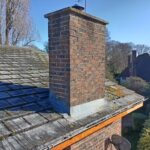
Flashing gets particular attention. The joins around chimneys, rooflights, dormers and where the roof meets a wall are among the most common sources of leaks. Lead can lift or crack, and mortar fillets can come away from the brickwork.
Please do not go onto the roof yourself to look. Roofs are dangerous to work on without the right equipment, and walking on tiles can break them and create new leaks.
Water testing
If the source still is not clear, a roofer may carry out a controlled water test. Using a hose, they wet one small section of the roof at a time, starting low and working upwards, while someone inside watches for water appearing. When a drip shows up, the roofer knows which section is letting water in. It is a slow process, but it pinpoints leaks that cannot be found by looking alone.
Moisture meters and thermal imaging
Flat roofs are harder. Water can enter at one point and spread a long way under the membrane before showing up inside. Moisture meters and thermal imaging cameras help here. Wet areas hold heat differently, so they show up as a different temperature on a thermal image, revealing trapped water that is invisible from the surface.
Not every leak is a roof leak
It is worth knowing that some apparent roof leaks come from elsewhere. Blocked gutters can overflow behind the fascia and run down inside the wall, creating damp that looks just like a roof leak. Faulty pipework, condensation in the loft and failed seals around windows can also be mistaken for roof problems. A thorough roofer will check these too, so you do not pay for roof work you did not need.
Why it pays to act quickly
A small leak rarely stays small. Over time, water rots roof timbers and battens, soaks insulation so it stops working, damages plaster and can eventually bring a ceiling down. Mould can also develop in damp lofts and rooms. The sooner the source is found, the simpler and cheaper the repair is likely to be.
Leak detection and repairs from Matrix & Son Roofing
If you have spotted a stain or a drip, call Matrix & Son Roofing. As a roofing company in Maidenhead, we will find the source of the leak, explain what has gone wrong and carry out a proper repair.